
News & events
Orielton House, Pembroke
Sunday 20 September at 2pm
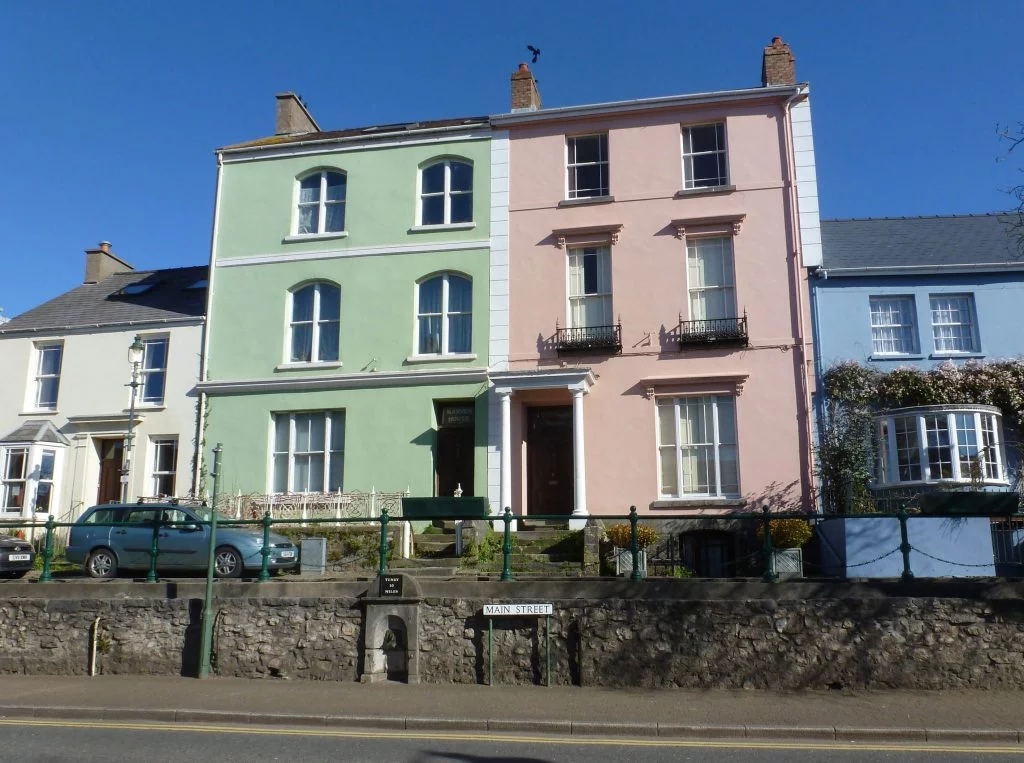
Orielton House is said to be the town house of the Owens of Orielton who once owned much of Pembroke and represented the borough in Parliament. The house is early 19th century with a garden that backs onto the town wall and the Millpond (the pink house in the photo below).
The current owner will show us around the property and David Ellis will give a talk on the history of the building and its previous occupants. Meet outside the house on Main Street at 2pm.
Trevor McCrory
It is with great sadness that we announce the passing of Trevor McCrory after a short illness.
Trevor was a long-time trustee of PHBT and always great fun. We will miss him terribly and our heartfelt wishes go out to his partner David.

Events held in 2026 so far …
Flimston Chapel and Ruins, Castlemartin Range
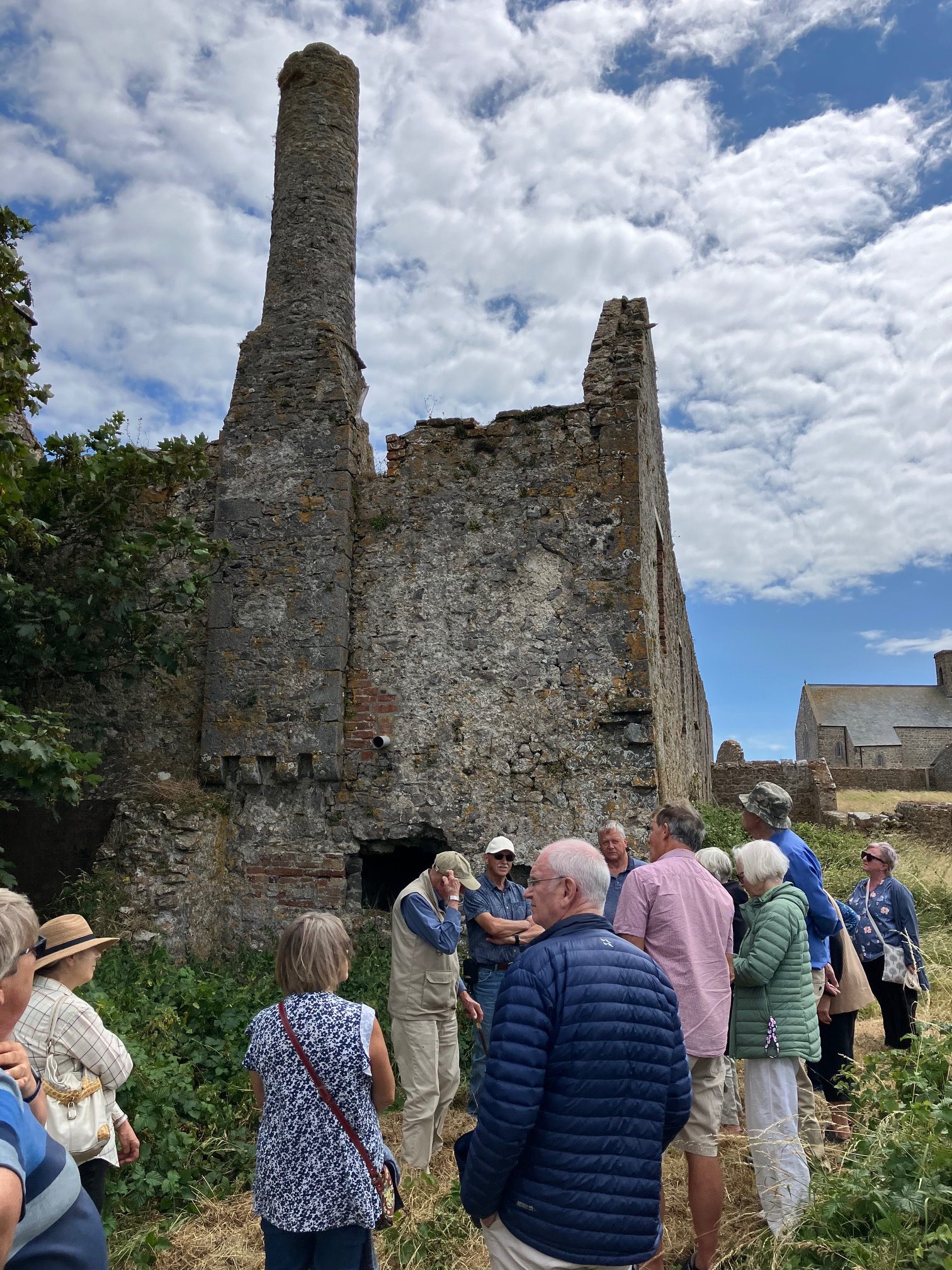
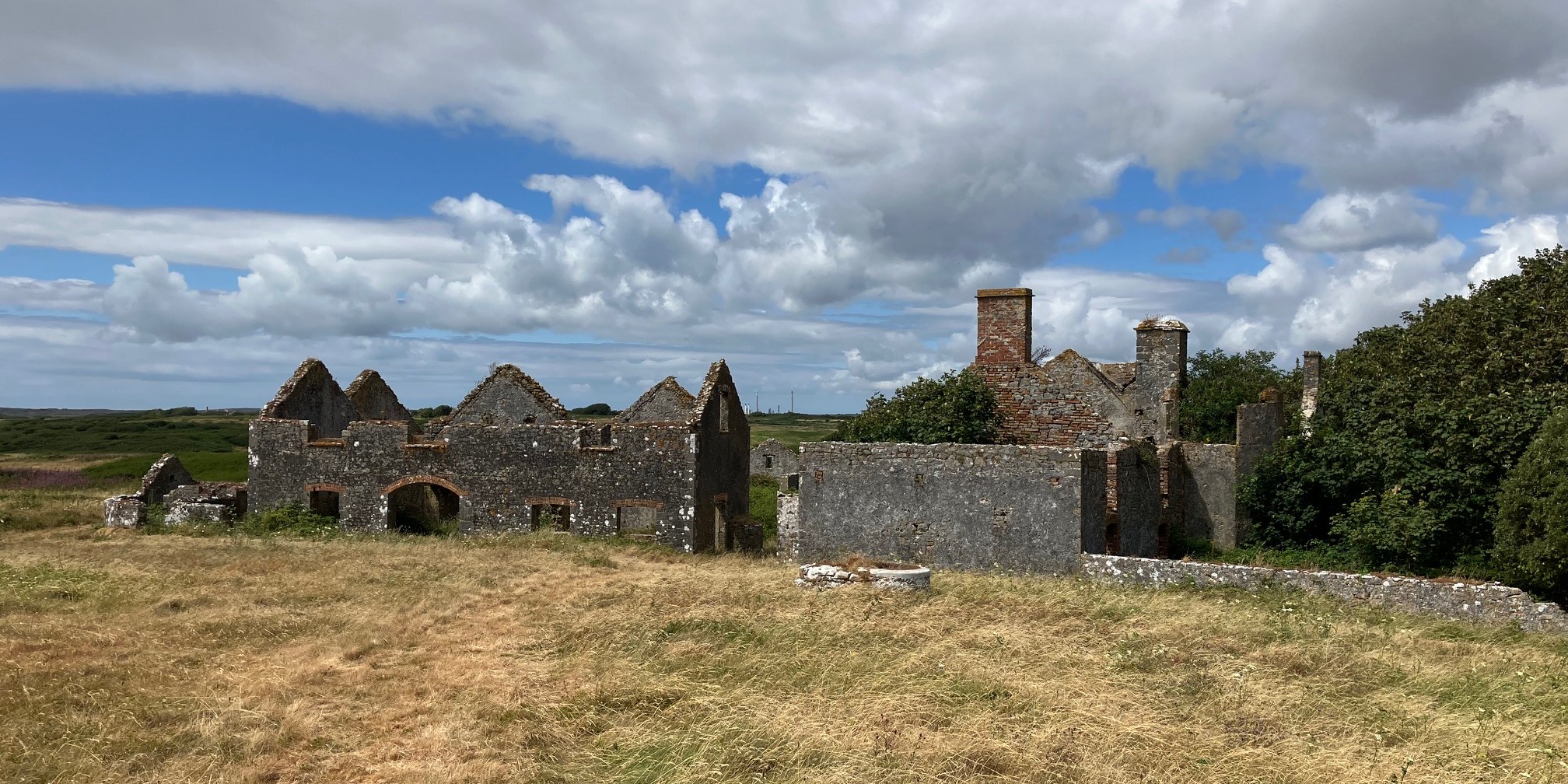
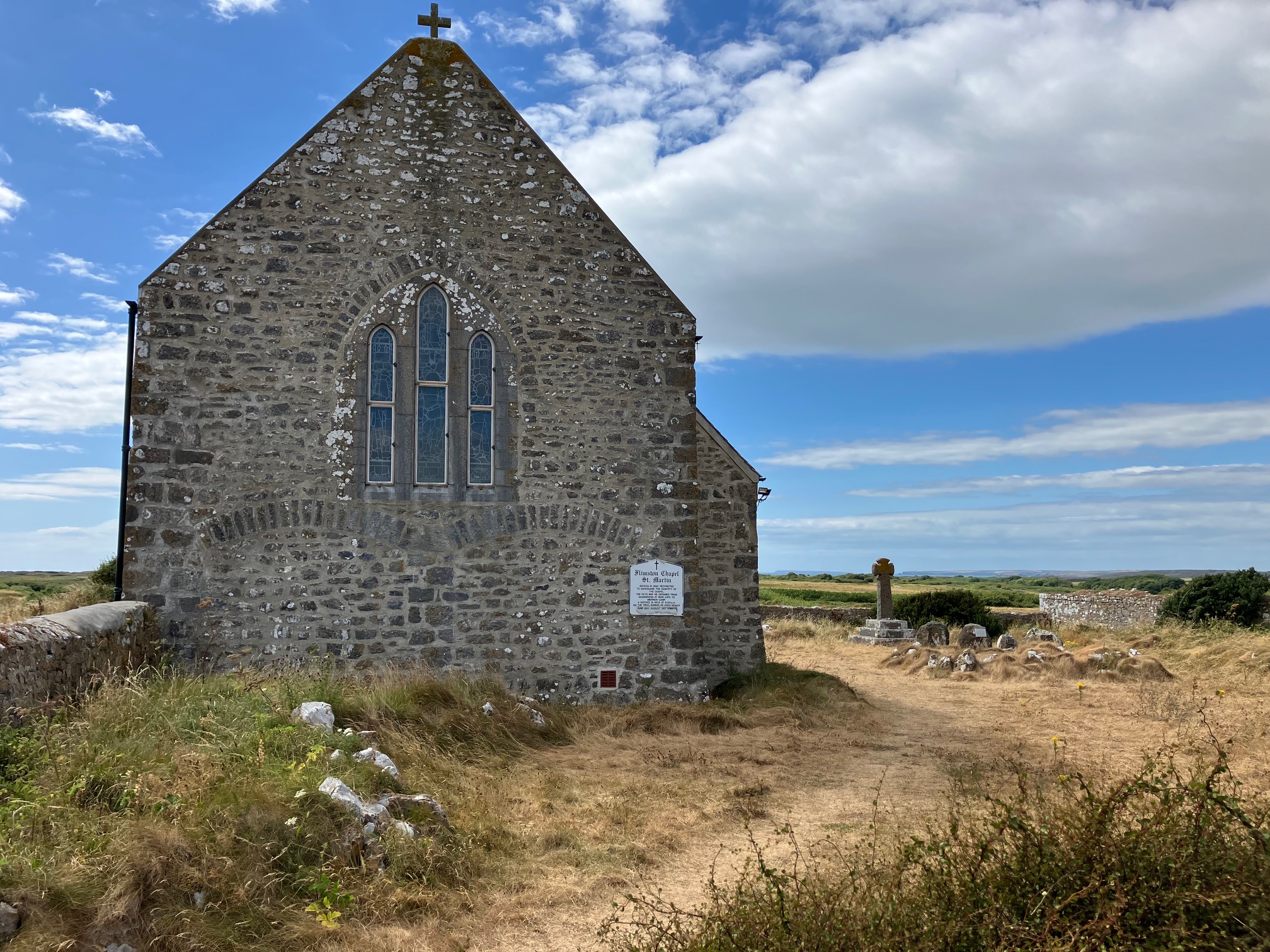
On a beautiful Pembrokeshire afternoon, and with the kind permission of Major Poole, fifteen members of PHBT visited the chapel and adjacent farmhouse ruins. David Ellis gave very interesting and informative talks on all the buildings, of which extracts are given below.
The chapel is a tall, medieval single chamber with a later C15/16th turret and corbelled parapet and big belfry. It fell out of use in the C18th and was reduced to a carthouse, the blocked windows of this visible under the east window. The chapel was taken in hand and presumably reconsecrated (?) by Colonel and Lady Lambton of Brownslade in 1903 in memory of their three sons, tragically all killed in the Boer war.
Internally the main structure is barrel vaulted in a pointed form rather than being roofed over in wood and slate. This very much reflects Pembrokeshire’s stone building tradition of stone vaulted undercrofts, a tradition probably influenced by the great castle building masons. The font, furnishings and stained glass are all of 1903. The memorials, all C20th are of the Lambtons, whose own house Brownslade, sadly has now sunk back into the soil. The Celtic cross outside dates only from 1909. A modest restoration was undertaken in 1963 which by using hard cement added to the dampness of the structure by retaining moisture within the walls.
The MOD took over this tract of countryside in 1938 as a tank range. What is hugely encouraging and why it is worth coming to see Flimston is the first class restoration of this building which was undertaken by the MOD in 2020. Under the guidance of Acanthus Holden in Pembroke and Kathryn Sayner of the DIO, hard cements were removed and repointing done in the correct lime/sand mix which allows the masonry to let moisture evaporate out of the structure. The roof was re-slated, lead flashings replaced and the whole structure coated in a lime/water wash. The cast iron rainwater goods were replaced, drains opened up and a new gate made. The church has monthly services and is used by the range for commemorations.
Flimston Farmhouse is an ancient house, the name probably deriving from its 1330 name Flemisston, the “house of the Fleming”. By 1785 it was owned by the Campbells of Stackpole with Robert Jones as tenant.
At the north end is a ground floor hall (C14th or C15th) with a cross wing containing a solar over undercrofts. Possibly the entry to the solar, a chamber which would have been private to the owner, was accessed from a stair adjacent to the west wall. A difficult house to interpret because so many later alterations took place. Very visible is the lateral solar chimney (“lateral” because it was not on the gable end of the house) set out on corbels and with a tall, circular shaft. The massive south gable chimney stack has a semi octagonal projection, possibly a medieval lookout. In the C18th the long east side was given regularly spaced sash windows. In the C19th a dairy was added on the west side and a service range on the south.
The adjacent farm buildings are mainly of later construction, but some incorporate medieval masonry, especially the L shaped barn to the east with a pointed doorway and a battered (sloping) gable end.
After the visit we drove to the Stackpole Walled Gardens for refreshments. The smoothies, coffee and cake are all highly recommended.
Chapel Bay Fort, Angle – Guided Tour
We had a fascinating and informative guided tour of the Fort and Museum by the two Johns and Emma who, with other volunteers, look after and maintain this amazing asset.
The fort is unique; first fort in the world built principally of mass concrete to a low-profile design and last in Britain built with a moat. This combination is both forward looking – designed to resist the impact of artillery attack by using a low-profile blending into the landscape, and backward looking in the use of a dry, vertically sided, defensive moat.
The fort and museum are both full of incredible weapons and armaments from the two World Wars and other conflicts. These items were collected by George, the driving force behind the preservation of the site, who has sadly passed away.
We were also shown the 3D map of the area showing the locations of the forts and batteries (planned and built) to protect the Haven from invasion – see photos below.
Afterwards we had tea, smoothies, cake and ice cream at the brilliant Wavecrest Cafe on Angle beach. Thanks to the staff there for reserving tables for us on a very busy sunny afternoon.


Stepaside Ironworks and Colliery
Who now would have known that coal and iron were excavated in the mid-eighteenth century, only a stone’s throw from a holiday park near Wiseman’s Bridge, if these important ruined buildings hadn’t been preserved?
The ore was obtained largely from levels driven in the cliffs between Saundersfoot and Amroth and transported by the branch line of the Saundersfoot Railway, which also carried pig iron to Saundersfoot for export. In its final stage the Iron Works consisted of 2 blast furnaces, blowing engines, coke ovens, workshops and lime kilns. The Works were only moderately successful: no pig iron was produced after 1874 and work ceased in 1877. The workshops were retained for service to local collieries until 1930.
Two talks were given prior to a walkover of the site:
Martin gave an explanation of the geology of the area and how the coal and iron deposits were formed; Sue then entertained us on the historical aspects of the site, the buildings and how the iron was produced.
Afterwards we drove to the Colby Gardens estate, another producer of coal in the late eighteenth century, where we had tea, coffee and cake at the National Trust tearoom.


Llawhaden Castle &
St Aidan’s Church


St David’s Cathedral
Guided Tour

Previous Events held in 2025
Five events and an annual lunch were held in 2025.
Annual lunch at Plas Hotel, Narberth
Thanks to everyone who attended the lunch and in particular to our guest speaker, Bishop Wyn, who gave a fascinating talk on St David’s Cathedral.
The difficulties that the bishops had in the seventeenth and eighteenth centuries in trying to keep the fabric of the building intact can only be imagined. However, the surprise was that the exterior of the building, medieval in appearance, was so altered and renovated by the Victorians. In particular the description of the works carried out to protect and maintain the west front of the building, although in Nash’s case causing more problems than it solved, showed the skill and ingenuity of the Victorian engineers to whom we owe a debt of thanks in preserving the building for the future.
Pembroke History Walk & St Mary’s Church
This very enjoyable walk and talk was led by young local historian, Owain Williams, who took us on a fascinating stroll around Pembroke. We started at the Henry VII statue and walked along the north wall by the Mill Pond as far as Barnard’s Tower then returned via Main Street, East Back and Chain Back. His fascinating talk took us all the way from the pre-Normans to Cromwell, via Henry VII, and up to more recent times. During the walk, Martin Bell described the restoration work that has recently been carried out by the Pembroke Town Walls Trust and plans for future work.
We ended the afternoon with a visit to the beautiful St Mary’s Church, where a talk was given by Ian Jones on the history of the building, followed by a tea – the meringues were amazing.

Freestone Hall, Cresselly
We had a brilliant visit to Freestone Hall with an interesting talk by Tom Lloyd on the history of the house.
We were told that in the mid C18th, Roger Allen, a younger son of the Allens of nearby Cresselly settled here and built a new house in 1768. Internally there is a surviving beautiful Chinese Chippendale staircase balustrade which was highly fashionable in the south of the county.
The house was remodelled by his grandson James Allen a London barrister but also a keen antiquary, who was first treasurer of the newly formed Cambrian Archaeological Association in 1846. In the later C19th the house was often let out while Thomas Allen worked in London. In 1910, it was purchased with its surrounding land by the Cresselly estate, whereafter it became a farmhouse until c.1980 when it returned to purely residential occupation.
Thanks to Martine Erussard, the current tenant of Freestone Hall, who prepared a lovely tea for us all.

Cilwendeg Shell House & Manordeifi Old Church
The Shell House is a remarkable ornamental grotto which was originally built in the 1820s as a fashionable garden retreat by the owners of the Cilwendeg Mansion at the time. This Grade II* listed building, along with an area of woodland is now owned by The Temple Trust, an historic building preservation charity. David Ellis gave a fascinating talk on the history of the building that was enjoyed by all our members as well as a couple of other visitors. This was followed by a visit to Manordeifi Old Church which is another remarkable building on the edge of the Teifi river valley. The day was rounded off at the Newport Memorial Hall where Sue prepared a fantastic tea which included individual alcoholic trifles. The tea bar has been raised!


Whitchurch House and Walled Garden & St David’s Church
We enjoyed a lovely afternoon hosted by John and Sara Manners-Bell at their house in Whitchurch on 11 May 2025. The work that has been completed at the old rectory is truly amazing with original features either kept or replicated by skilled craftsmen, including all of the Georgian-style windows in this early Victorian era building. John provided an excellent slide show of the history of the house, which was designed and built around 1843, and its remarkable survival when the adjacent St David’s Airfield was constructed during WWII. Sara showed us around the walled garden which has had a new wall built on one side, although it’s hard to tell which wall is the new one as the workmanship is so good! The planting of the garden is a work in progress and we hope to be invited back for a re-visit when it has matured. Thanks to Sara for the tea which was excellent.
Thanks also to Brenda, the church warden, and the Rev. Belinda Roberts for letting us visit the beautiful church of St David’s in Whitchurch and for their telling of the fascinating history of the building. We hope that the Church of Wales has a change of heart and allows the church to remain open as place for community activities, if not for religious services.


Annual General Meeting at Little Newcastle
The AGM was held at St Peter’s Church Little Newcastle on 23 March 2025. A big thank you to the Rev. Richard Davies for his fascinating talk on the history of the church, which dates back to the medieval period, and on the current building which this year marks its 150th anniversary. The collection of modern stained glass windows that were installed in the church in the 1990s are stunning.
Thanks also to the ladies of the church for the fantastic tea.

News
As part of our mission to help in the restoration of significant historical buildings in Pembrokeshire, we are pleased to announce that PHBT has been able to make significant donations to two local projects:
The Pembroke Town Walls Trust, working with a wide range of partners is undertaking the repair and consolidation of the remains of the town walls. In doing so, they are aiming to protect and conserve the archaeology, promote understanding and access, and realise the potential of the historic site. More details can be found on their website:
The Shell House is owned by The Temple Trust, an historic building preservation charity. The restoration works were completed in 2007. However, water ingress has caused more damage to the building and further costly remedial work is required, hence the need for additional funding. More details can be found on their website:


